
World Fuel Cell Conference 2025
July 9-12, 2025, Hong Kong, China

Conference Objectives
The 2025 World Fuel Cell Conference (WFCC) is a multi-disciplinary conference that covers the latest developments and advancements in fuel cells, hydrogen energy and the inter-connection, from fundamentals, to advanced materials, advanced characterization techniques, engineering designs, system integration, and applications. It will provide an excellent platform for scientists, engineers, industrial practitioners, and governmental policy makers to exchange ideas and seek collaborations on the development and applications of fuel cells, hydrogen energy, and the inter-connection.
Venue
The conference will be held at Hong Kong, China.
Conference Format
Plenary/keynote presentations by invited speakers
General contributed abstracts presented orally in technical sessions and/or by posters
Tutorials about fuel cell and hydrogen energy technologies by invited leading researchers
Abstract/Paper Submission
Only abstracts are needed for presentation at the 2025 WFCC.
Based on the oral and/or poster presentations, the conference organizing committee will shortlist abstracts for full paper submission for special issues of peer-reviewed international journals.
Topics
WFCC welcomes abstracts in all areas of fuel cell and hydrogen energy technologies, including but not limited to:
Theme 1: Fuel Cells
Fuel cell materials, components, cells, stacks, and systems
Modeling and optimization: materials, cells, stacks, and systems
Testing, characterization, and diagnostics of fuel cells
Applications of fuel cells: mobile, stationary, portable, specials
Theme 2: Hydrogen Energy Technologies
Hydrogen production: electrolysis (AWE, PEMEC, SOEC, PCEC, etc.), reforming, thermochemical cycles, photocatalysis, biological processes, and other potential technologies for hydrogen production
Hydrogen storage: compressed gas, liquid hydrogen storage, metal hydride, containers, ammonia
Hydrogen transportation and hydrogen infrastructure
Theme 3: Inter-connection
Hydrogen economy: BEV vs. FCEV, Hybrids
On board hydrogen storage
Life cycle analysis: round trip efficiency of hydrogen & electricity generation, environmental impact assessment
AI for fuel cells and hydrogen energy
Renewable energy resource coupling: SOFC-SOEC, PEMFC-PEMEC etc.
Important Dates
Deadline for abstract submission: 31 March 2025
Deadline for early bird registration: 30 April 2025
Deadline for regular registration: 31 May 2025
Awards
Best Presentation Awards (excluding plenary/keynote presentations)
Best Poster Awards
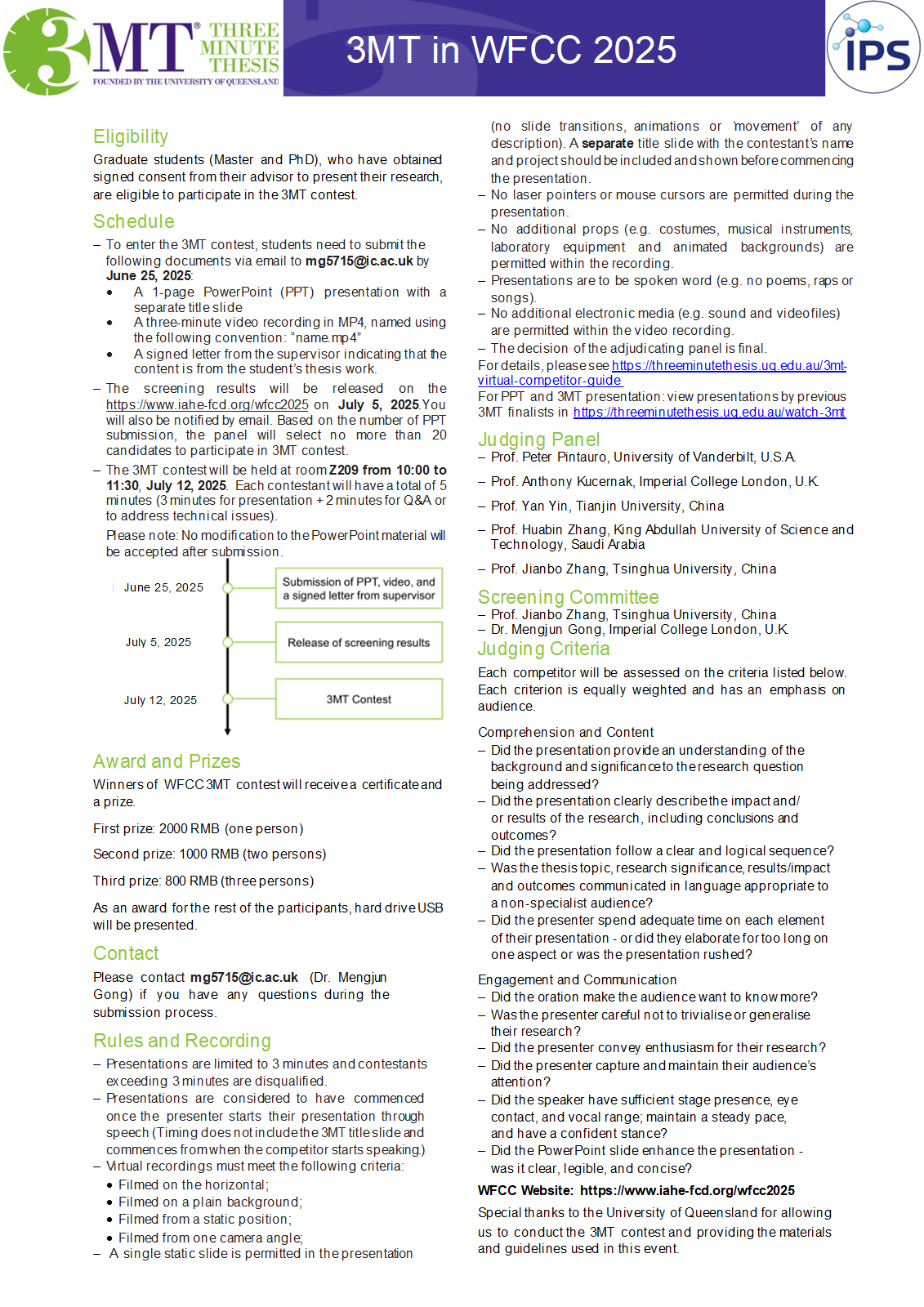
3 Minutes Thesis (3MT) Competition
General Contact
meng.ni@polyu.edu.hk (Prof. Meng Ni)




Call for Abstract

Abstract Submission
Acknowledgement: The Microsoft CMT service was used for managing the peer-reviewing process for this conference. This service was provided for free by Microsoft and they bore all expenses, including costs for Azure cloud services as well as for software development and support.
Submission of abstracts has to be performed electronically using the template available below, you can choose to give an oral presentation or present a poster.
The deadline is 31 March 2025.
It takes 10 minutes presentation and 5 minutes Q&A for oral presentations, and the powerpoint format is 16:9. For poster presentations, the poster size is A0.
Theme 1: Fuel Cell
1) Types of fuel cell: PEMFC, DMFC, SOFC, PAFC, AFC
2) Materials and components: catalysts and their supports, GDLs, MPLs, MEAs, bipolar plates, membranes, ionomers
3) Modelling design, optimization: materials, cells, stacks, systems
4) Applications: mobile, stationary, portable, specials
Theme 2: Hydrogen
1) Hydrogen production: Electrolysis (PEMEC, SOEC), reforming, photolysis, anaerobic
2) Hydrogen storage: compressed gas, cryogenic liquid, metal hydride, chemicals, container
3) Hydrogen transport: trucking, pipeline, railway, ship
4) Hydrogen infrastructure: fuelling station, distribution centres
Theme 3: Inter-connection
1) Hydrogen economy: BEV vs. FCEV, Hybrids
2) On board hydrogen storage
3) Lifecycle analysis: round trip efficiency of hydrogen & electricity generation, environmental impact assessment
4) Renewable energy resource coupling: SOFC-SOEC, PEMFC-PEMEC
Committees
Prof. Meng NI - The Hong Kong Polytechnic University
Prof. Xianguo Li - University of Waterloo
Prof. Jianbo ZHANG - Tsinghua university
Prof. AN Liang - The Hong Kong Polytechnic University
Prof. Jian WANG - City university of Hong Kong
Prof. LI Weihong - City university of Hong Kong
Prof. LI Mengying - The Hong Kong Polytechnic University
Program
Invited Speakers
Plenary Speakers
John Irvine
University of St Andrews, Scotland
Presentation Title: Interfacial Engineering in Solid Oxide Cells
Kui Jiao
Executive Director of National Industry-Education Platform for Energy Storage,
Tianjin University, China
Presentation Title: ETSim: An Electrochemical Thermophysics Simulator Enhancing Fuel Cell Design
Anthony Kucernak
Imperial College of London, England
Department of Chemistry - Faculty of Natural Sciences
Jing-Li Luo
Shenzhen University, China
Presentation Title: PEROVSKITE ELECTROCATALYSTS FOR SOLID OXIDE FUEL CELLS/SOLID OXIDE ELECTROLYSIS CELLS
Peter N. Pintauro
Vanderbilt University, Nashville, Tennessee, USA
Presentation Title: Recent Advances in Electrospun Nanofiber Mat Electrodes for Fuel Cells
Zhigang Shao
Dalian Institute of Chemical Physics, China
Zongping Shao
Curtin University, Australia
Presentation Title: A semi-vapor electrolysis technology for efficient hydrogen generation from untreated water
Yunan Wang
Ningbo Institute of Materials Technology & Engineering, China
Takeo YAMAGUCHI
Institute of Science Tokyo, Japan
Presentation Title: Systematic material design and development for polymer electrolyte fuel cells and anion exchange membrane water electrolysis
Eileen Yu
University of Southampton, UK
Presentation Title: Microbial electrochemical systems for simutaneous hydrogen production and wastewater treatment
Keynote Speakers
Takuto Araki
Yokohama National University, Japan
Yu Chen
South China University of Technology, China
Presentation Title: Oxygen Electrodes for Reversible Protonic Ceramic Electrochemical cells
Francesco Ciucci
University of Bayreuth
Presentation Title: Cobalt-Free Air Electrodes for Protonic Ceramic Cells
Shangfeng Du
School of Chemical, University of Birmingham, UK
Presentation Title: Hydrogen crossover for differential pressure PEM water electrolysers
Donglin Han
Soochow University, China
Presentation Title: Transport Properties of Proton Conducting Perovskite Zirconates and Cerates
Piran R Kidambi
Vanderbilt University
Presentation Title: Overcoming the Conductance versus Crossover Trade-off in State-of-the-Art Proton Exchange Fuel-Cell Membranes by Incorporating Atomically Thin Chemical Vapor Deposition Graphene
Hidenori Kuroki
Institute of Science Tokyo, Japan
Presentation Title: Connected Nanoparticle Catalysts and Support-Free Catalyst Layers for PEFCs
Rui Lin
Tongji University, China
Presentation Title: Design of three-phase interface for low-platinum fuel cell and innovative development
Youjun Lu
Xi’an Jiaotong University
Presentation Title: Integrated Hydrogen Production and Storage through Thermal -Electrical Coupling
Wanlu Li
University of California San Diego
Presentation Title: Physics-Guided Structural Prediction for Sub-Nanometer Clusters and Multi-Element Nanoparticles for Sustainable Materials Design
Zhipeng Li
Northwestern Polytechnical University, China
Presentation Title: SOFC-From Material Research to Industrial Manufacture
Zhiguo Qu
Xi’an Jiaotong University, China
Presentation Title: Modeling Development on MEA Degradation and AI-based Lifetime Prediction of Proton Exchange Membrane Fuel Cells
Shuhui Sun
Institut National de la Recherche Scientifique (INRS), Canada
Presentation Title: Low-Cost, High-Performance Electrocatalysts for Sustainable Hydrogen Production: From Non-Precious Materials to Single-Atom Catalysts
Peichen Su
Nanyang Technological University, Singapore
Presentation Title: Surface Modification of Solid Oxide Fuel Cell Electrodes for Performance and Stability
Huabing Tao
Xiamen University, China
Presentation Title: Degradation Mechanism of Anode Catalyst Layers of PEM Water Electrolyzers
Baoguo Wang
Tsinghua University, Beijing, PRC
Presentation Title: 3D CATALYTIC NANOARRAYS VERTICALLY INTERLOCKED ON aION EXCHANGE MEMBRANE FOR mea USING IN WATER ELECTROLYSIS
Yun Wang
UC Irvine, United States
Presentation Title: Modeling Reversible Fuel Cells of High Round-Trip Efficiency
Gang Wu
Washington University in St. Louis, United States
Presentation Title: Single Metal Site Catalysts for PEM Fuel Cells
Liangfei Xu
Tsinghua University, Beijing, China.
Presentation Title: Application of AI-based methods in design and diagnosis of proton exchange membrane fuel cell
Changrong Xia
University of Science and Technology of China
Presentation Title: Temperature induced relaxation for determining oxygen transport kinetics of nonstoichiometric oxides
Yan Yin
Tianjin University, China
Presentation Title: Design of advanced low precious metal electrodes for AEM water electrolysis
Huabin Zhang
King Abdullah University of Science and Technology
Presentation Title: Advancing Heterogeneous Electrocatalysis with Trans-scale Chemistry
Invited Speakers
Bin Chen
Shenzhen Univerisity
Presentation Title: Reliable faradaic efficiency by breaking mass transportation limit in scaled-up proton conducting electrolysis cells
Di Chen
Tsinghua University
Presentation Title: Investigating SOFC Electrode Reaction Mechanism Using Atomically Flat Surface
Yubin Chen
Xi’an Jiaotong University
Presentation Title: PEM water electrolysis for high-pressure hydrogen production and the H2 crossover mechanism
Kongfa Chen
Fuzhou University, China
Presentation Title: Progress of direct assembly approach for constructing efficient, durable nanocomposite hydrogen electrodes for solid oxide cells
Yubo Chen
Zhejiang University, China
Presentation Title: Support-free iridium hydroxide for high-efficiency proton-exchange membrane water electrolysis
Xingxing Cheng
Shandong University
Presentation Title: Green monomer synthesized hyper-crosslinked polymers carbon material and molecular simulation
Linhao Fan
Tianjin University
Presentation Title: Molecular-level insights into mass transfer in fuel cell cathode electrodes
Huihuang Fang
Fuzhou University
Presentation Title: Ammonia-Hydrogen Energy Conversion and Utilization Technologies
Jianbing Huang
Xi’an Jiaotong University
Presentation Title: Superprotonic Conduction in Ruddlesden-Popper Perovskite Electrolyte for Low-Temperature Solid Oxide Fuel Cells
Farrukh Khalid
Indian Institute of Technology Guwahati
Presentation Title: High-Temperature Electrolysis for Hydrogen and Other Value-Added Products
Ang Li
Shanghai Jiao Tong University
Presentation Title: Multiphysics-induced heterogeneous degradation of nickel-CGO cathode in solid oxide electrolysis cell
Molly Meng-Jung Li
The Hong Kong Polytechnic University
Presentation Title: Ammonia-powered zero-carbon versatile-energy supply station
Dong LIU
Nanjing University of Science and Technology
Presentation Title: Biomimetic Membrane-Less Electrolysis
Tong LIU
Wuhan Institute of Technology
Presentation Title: Hierarchically oriented electrodes with open, straight pores for efficient solid oxide cells application
Yu Luo
Fuzhou University
Presentation Title: Ammonia-Hydrogen Energy Conversion and Utilization Technologies
Shanke Liu
Shanghai Jiao Tong University
Presentation Title: Energy management of fuel cells in hydrogen-electric coupling systems
Wonyoung Lee
Sungkyunkwan University
Presentation Title: Low temperature operation of protonic ceramic electrochemical cells
He Miao
Ningbo University, PR China
Presentation Title: Multi-component Ni-based alloys prepared by electrodeposition and their alkaline water electrolysis performances
Yutong Mu
Xi’an Jiaotong University, PR China
Presentation Title: Mesoscopic Insights into the Reactive Transport Processes in Membrane Electrode Assemblies of PEMFCs
Zhiqiang Niu
Loughborough University, UK
Presentation Title: Generative AI in Green Hydrogen: Innovations and Opportunities
Zhefei Pan
Chongqing University
Presentation Title: Building an ammonia fuel cell with an anion exchange membrane
Ranran Peng
University of Science and Technology of China
Presentation Title: Rational Design of Heterogeneous Catalysts via Surface Exsolution: Thermodynamic Drivers and Electronic Modulation for Enhanced CatalyticPerformance
Qi Ronghui
South China University of Technology
Presentation Title: Non-equilibrium Thermodynamics-based Impedance Modeling for PEM-based Humidity Electrolysis
Jing Shao
Shenzhen University
Presentation Title: Surface reconstruction of catalysts during water electrolysis: in situ analysis and modulation
Shuanglin Shen
China University of Mining and Technology
Presentation Title: Experimental Measurement of the ‘Real’ Temperature Distribution in a Planar Solid Oxide Fuel Cell
SHI Xingyi
City University of Hong Kong (Dongguan)
Presentation Title: Operation of an Energizing Liquid Fuel Cell in Sub-Zero Conditions
Yuefeng Song
Dalian Institute of Chemical Physics, China
Presentation Title: High-temperature Electrocatalysis in Solid Oxide Electrolysis Cells
Jie YU
Jiangsu University of Science and Technology
Presentation Title: Structural regulation and performance optimization of energy-related catalytic materials
Yang Wang
Chongqing University
Presentation Title: Trans-scale Modeling of electrochemical CO2 Reduction
Bowen Wang
Tianjin University
Presentation Title: Electrochemical reaction and transport in the anode of direct ammonia fuel cells (DAFCs)
Yuqing Wang
Beijing Institute of Technology
Presentation Title: Mechanism Studies and Stack Integration of Tubular Solid Oxide Fuel Cells
Qianqian Wang
University of Shanghai for Science and Technology
Presentation Title: Investigating Hydrogen Crossover in Proton Exchange Membrane Fuel Cells: Impacts on Performance and Longevity
Jingyi Wang
The Hong Kong Polytechnic University
Yifei Wang
Harbin Institute of Technology, Shenzhen
Presentation Title: Microfluidic fuel cell for combined cooling and power applications
Zhen Wu
Xi’an Jiaotong University
Presentation Title: Multiscale Analysis of Degradation Mechanisms and Performance Prediction in Solid Oxide Fuel Cells
Wei Wu
Chinese Academy of Sciences
Presentation Title: Revitalizing performance of protonic ceramic cells by interfacial acid etch
Ting Wu
Lincoln Agritech Ltd, Lincoln University, New Zealand
Presentation Title: Turning agricultural methane into opportunity: electrochemical methane mitigation and hydrogen generation
Wenshuo Xu
University of Cambridge, UK
Presentation Title: Synthesis and Catalysis of Emerging 2D Materials
Meigui Xu
Nanjing Tech University
Presentation Title: Performance Optimization of Proton Ceramic Cells
Yang Yang
Chongqing University
Presentation Title: Triply periodic minimal surface foams for PEM electrolyzer and methanol reforming hydrogen production applications
Dingding Ye
Chongqing University, China
Presentation Title: Pump-free microfluidic fuel cells and electrochemical analytical devices
Gaoqiang Yang
Hunan University
Structured Electrode-Membrane InterfaceEnabling High-Performance Proton Exchange Membrane Fuel Cells
Keqing Zheng
China University of Mining and Technology
Presentation Title: A Two-Stage SOFC System for Methane Power Generation with Carbon Capture
Guobin Zhang
Xi’an Jiaotong University
Presentation Title: Multi-physics modeling and structure design for high-power-density PEM fuel cells
Caizhi Zhang
Chongqing University
Presentation Title: Fault diagnosis of Proton Exchange Membrane Fuel Cells based on impedance analysis
Gaixia Zhang
University of Quebec, Canada
Presentation Title: Low-Pt and Pt-free Catalysts for PEM fuel cells
Yanxiang Zhang
Harbin Institute of Technology
Presentation Title: A new approach for understanding the current-voltage relationship
Lin Zeng
Southern University of Science and Technology
Presentation Title: Multiscale Modeling and Optimization of Water Management in Anion Exchange Membrane FuelCells for Enhanced Performance and Durability
Workshop
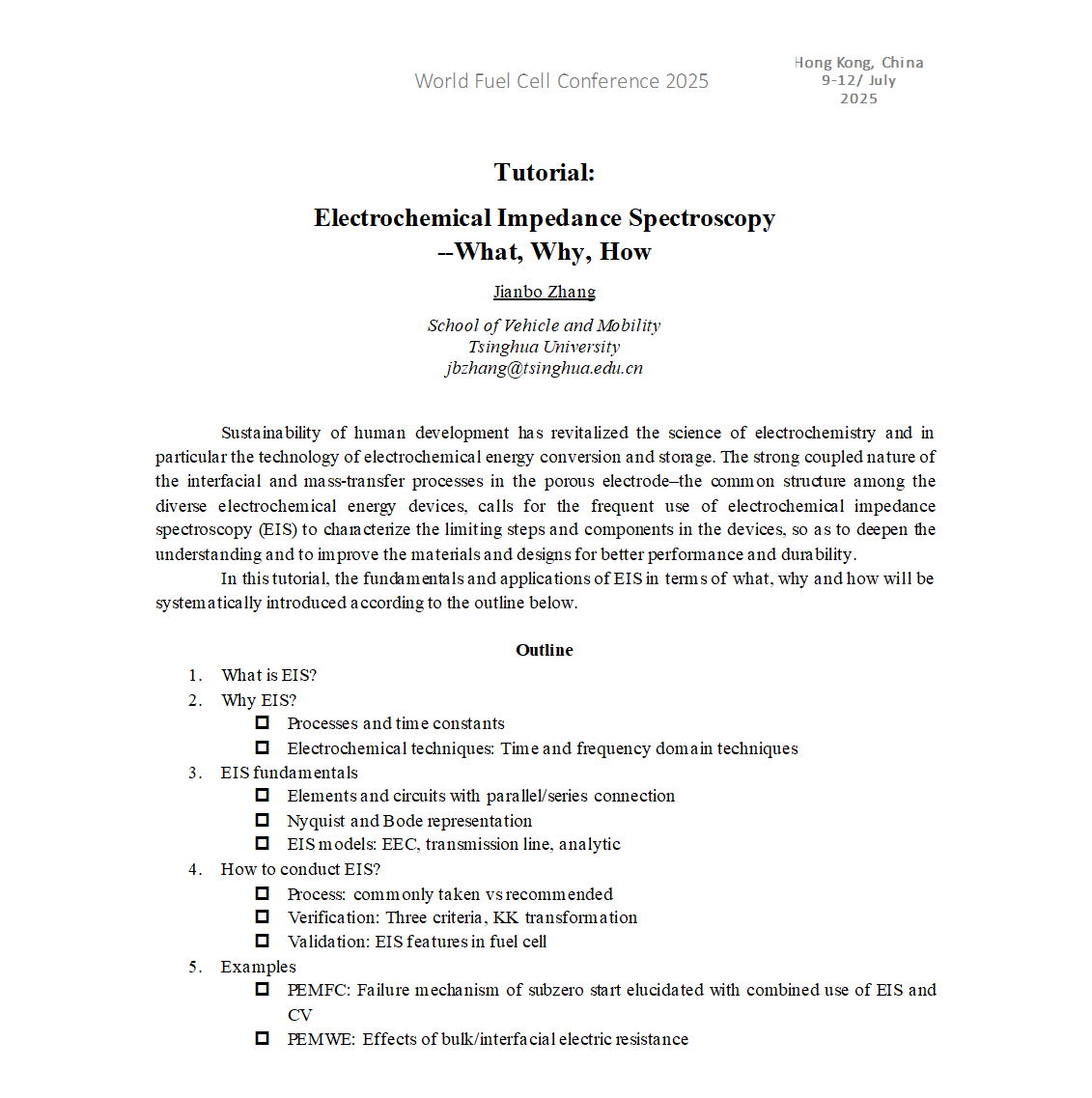
Dr. Jianbo Zhang got his PhD on Aerodynamics in the University of Tokyo, Japan. He worked in Nissan Research Center on the R&D of fuel cell and LIB during 2000~2011. He was offered the professorship in the Department of Automotive Engineering, Tsinghua University, China in 2011.
His research interests center around the diagnosis and design of electrochemical energy devices such as fuel cell, lithium-ion cell, and water electrolyzer. He co-authored the book The Theory and Application of the Structure Design for Lithium-Ion Batteries (in Chinese), the chapter “Electrochemical Impedance Spectroscopy” in the book “Microscopy and Microanalysis for Lithium-Ion Batteries”, and the chapter “Subzero startup of polymer electrolyte fuel cell” in the book Fuel Cells for Transportation.
He is the chair of the Scientific Committee of International Symposium of Electrochemical Impedance Spectroscopy, a member of the Fuel Cell Division of the International Association of Hydrogen Energy, a member of the Scientific Committee of European Fuel Cell Forum.
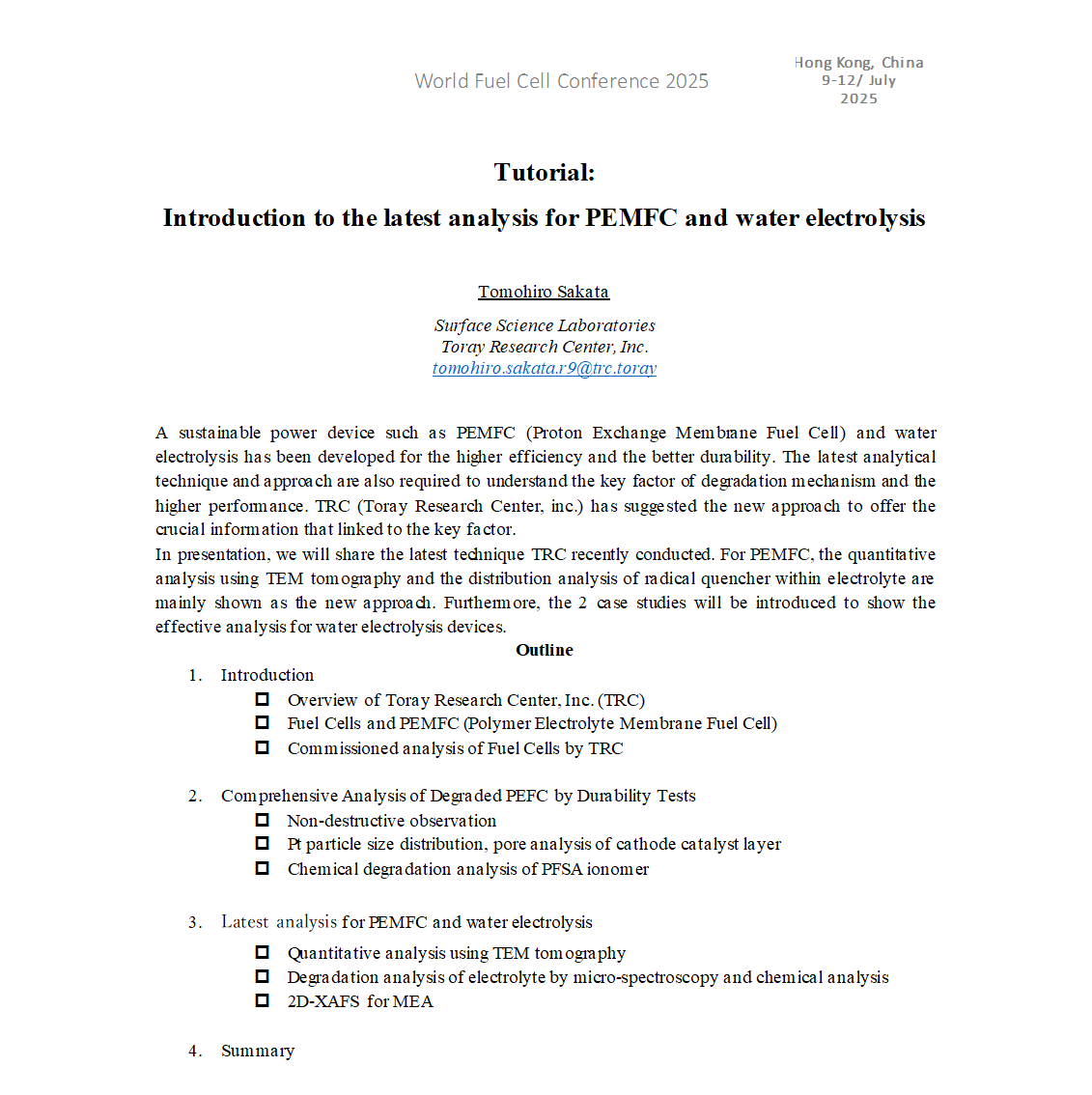
Dr. Tomohiro Sakata is senior research chemist using photoelectron spectroscopy in Toray Research Center. He received Ph.D. in surface physics in 2014. He worked at Innovation Research center for fuel cells, the university of Electro-Communications after postdoc at RWTH Aachen university. His area of expertise is the analysis of semiconductor using photoelectron spectroscopy and fuel cells using X-ray Absorption Fine Structure.
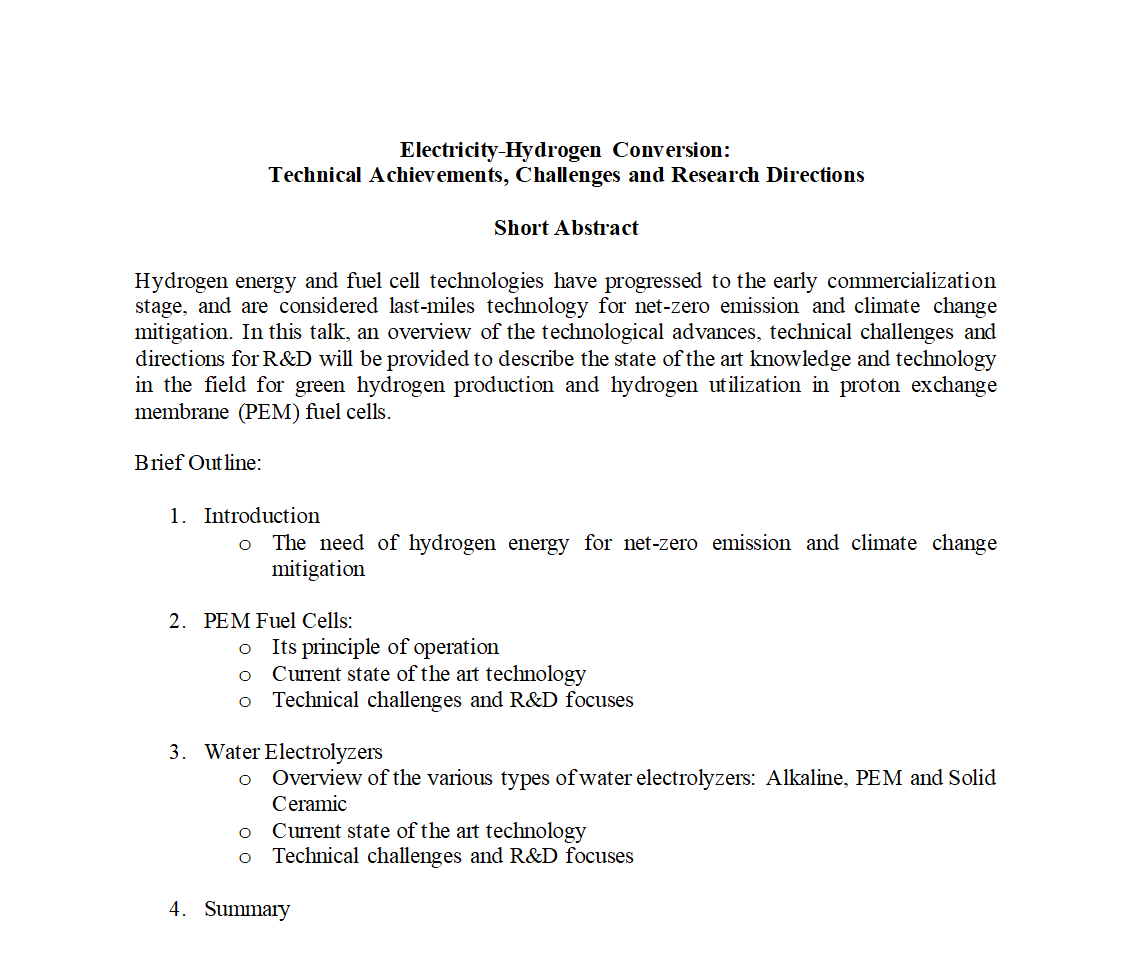
Dr. Xianguo Li is a Professor of Mechanical and Mechatronics Engineering at the University of Waterloo. His research interests include hydrogen energy and fuel cells, liquid fuel atomization and sprays, and green energy systems, as well as the thermal management of power batteries for electric vehicles. Dr. Li has published extensively, including the book “Principles of Fuel Cells” (single-authored) and “Fuel Cells for Transportation: Fundamental Principles and Applications” (co-edited). He serves as the editor in chief for the International Journal of Green Energy, Field Chief Editor for Frontiers in Thermal Engineering; Senior Vice President, Canadian Society for Mechanical Engineering (CSME), and President, International Association for Green Energy (IAGE). He is a fellow of Canadian Academy of Engineering, Engineering Institute of Canada and CSME.
3MT Competition
Conference Publication
High-quality abstracts/papers submitted to WFCC 2025 will be recommended for publications in special issues being organized in the following journals.
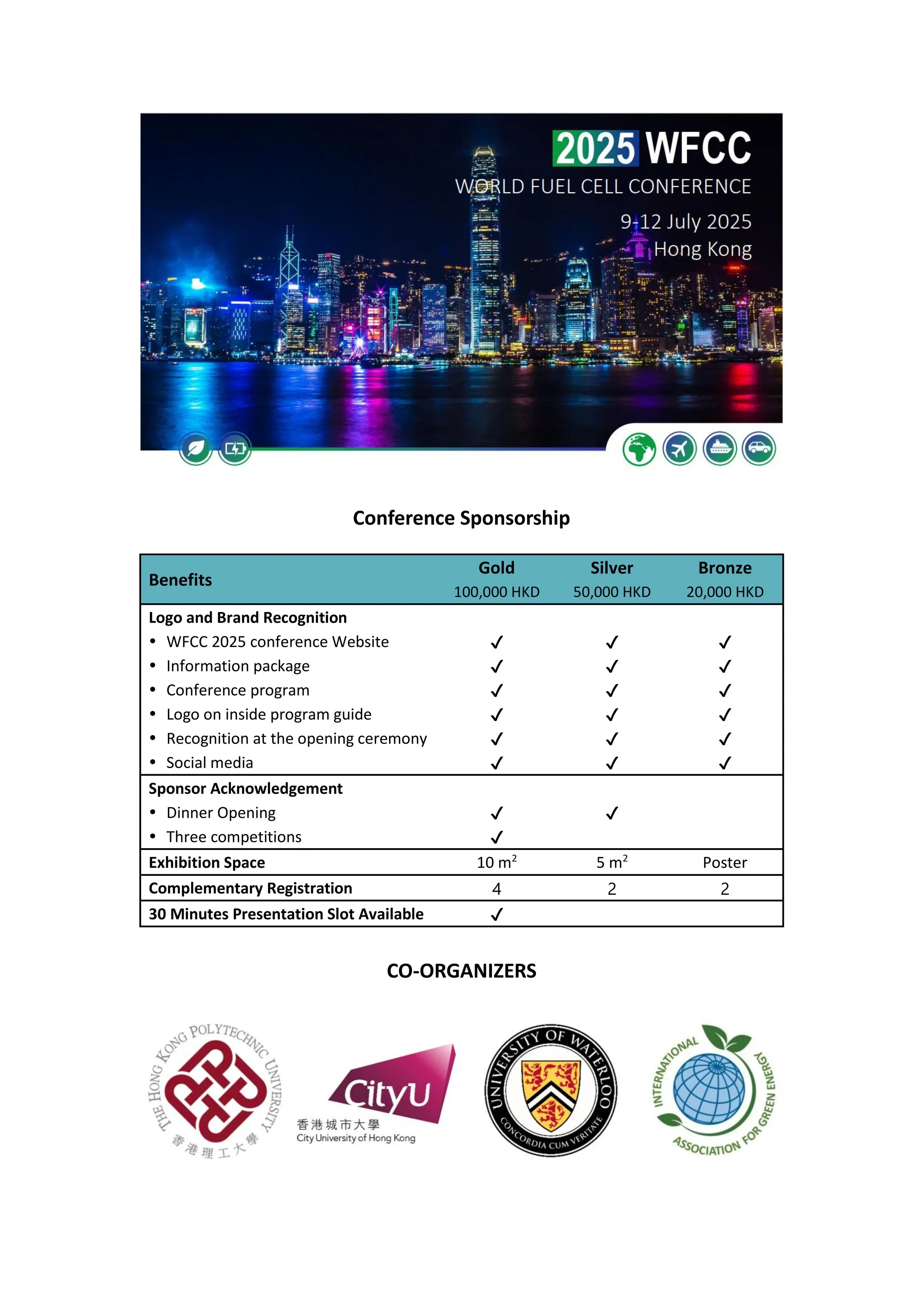
Sponsorship
Important Dates
Deadline for abstract submission: 31 March 2025
Deadline for early bird registration: 30 April 2025
Deadline for regular registration: 31 May 2025
Conference Dates: 9-12 July 2025