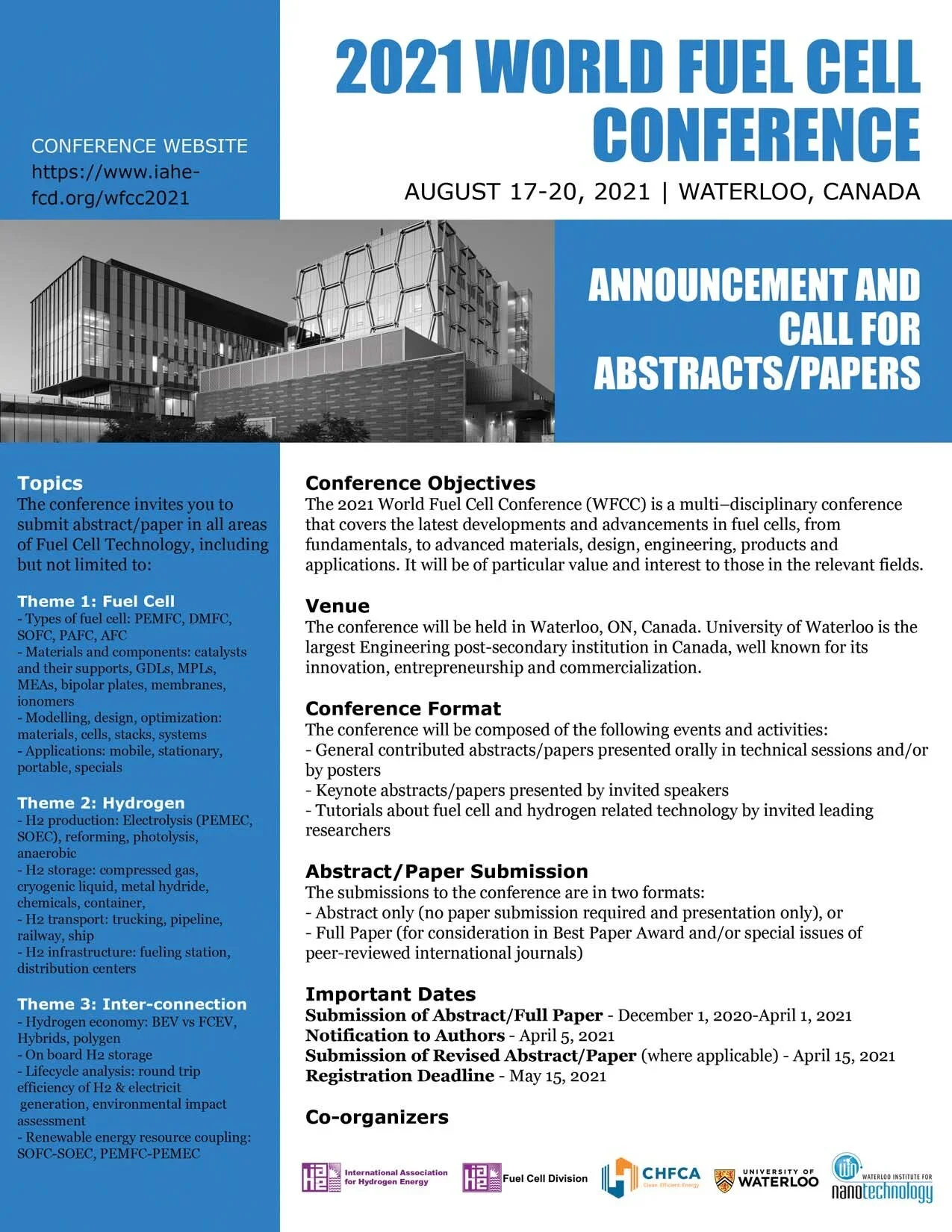
World Fuel Cell Conference 2021
August 16-20, 2021, University of Waterloo, Waterloo, CA

The Conference is organized by IAHE Fuel Cell Division, hosted by the Waterloo Institute for Nanotechnology (WIN) and the Canadian Hydrogen and Fuel Cell Association (CHFCA).
The WFCC is a multidisciplinary conference on the latest development and advancement of hydrogen and fuel cells, and provides a forum for the exchange of the latest scientific and technical information, for the dissemination of high-quality research results, and for the debate and shaping of future directions and priorities in hydrogen fuel cell science, technology, engineering, application and commercialization. This conference is targeting technical issues and interconnections between fuel cells and hydrogen.
Call for Abstracts
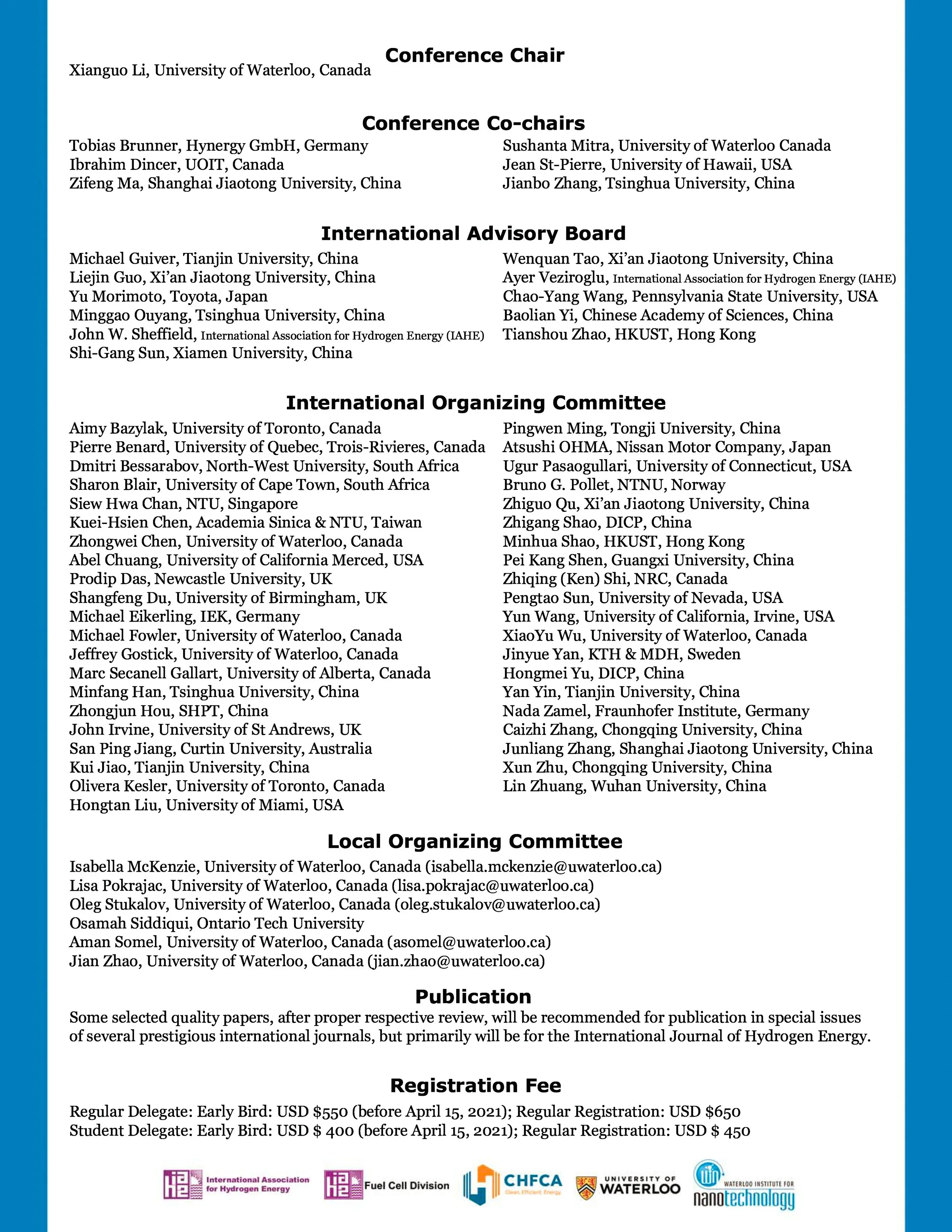
Conference Committee
Conference Chair
Xianguo Li, University of Waterloo, Canada
Conference Co-chairs
Tobias Brunner, Hynergy GmbH, Germany
Ibrahim Dincer, University of Ontario Institute of Technology, Canada
Zifeng Ma, Shanghai Jiaotong University, China
Sushanta Mitra, University of Waterloo, Canada
Jean St-Pierre, University of Hawaii, USA
Jianbo Zhang, Tsinghua University, China
International Advisory Board
Michael Guiver, Tianjin University, China
Liejin Guo, Xi’an Jiaotong University, China
Yu Morimoto, Toyota, Japan
Minggao Ouyang, Tsinghua University, China
John W. Sheffield, International Association for Hydrogen Energy (IAHE)
Shi-Gang Sun, Xiamen University, China
Wenquan Tao, Xi’an Jiaotong University, China
Ayer Veziroglu, International Association for Hydrogen Energy (IAHE)
Chao-Yang Wang, Pennsylvania State University, USA
Baolian Yi, Chinese Academy of Sciences, China
Tianshou Zhao, Hong Kong University of Science and Technology, Hong Kong
International Organizing Committee
Aimy Bazylak, University of Toronto, Canada
Pierre Benard, University of Quebec, Trois-Rivieres, Canada
Dmitri Bessarabov, North-West University, South Africa
Sharon Blair, University of Cape Town, South Africa
Siew Hwa Chan, Nanyang Technological University, Singapore
Kuei-Hsien Chen, Academia Sinica & National Taiwan University, Taiwan
Zhongwei Chen, University of Waterloo, Canada
Abel Chuang, University of California Merced, USA
Prodip Das, Newcastle University, UK
Shangfeng Du, University of Birmingham, UK
Michael Eikerling, Institute of Energy and Climate Research, Germany
Michael Fowler, University of Waterloo, Canada
Jeffrey Gostick, University of Waterloo, Canada
Marc Secanell Gallart, University of Alberta, Canada
Minfang Han, Tsinghua University, China
Zhongjun Hou, Shanghai Hydrogen Propulsion Technology Co., Ltd., China
John Irvine, University of St Andrews, UK
San Ping Jiang, Curtin University, Australia
Kui Jiao, Tianjin University, China
Olivera Kesler, University of Toronto, Canada
Hongtan Liu, University of Miami, USA
Pingwen Ming, Tongji University, China
Atsushi OHMA, Nissan Motor Company, Japan
Ugur Pasaogullari, University of Connecticut, USA
Bruno G. Pollet, Norwegian University of Science and Technology, Norway
Zhiguo Qu, Xi’an Jiaotong University, China
Zhigang Shao, Dalian Institute of Chemical Physics, China
Minhua Shao, Hong Kong University of Science and Technology, Hong Kong
Pei Kang Shen, Guangxi University, China
Zhiqing (Ken) Shi, National Research Council of Canada, Canada
Yujiang Song, Dalian University of Technology, China
Pengtao Sun, University of Nevada, USA
Yun Wang, University of California, Irvine, USA
Zidong Wei, Chongqing University, China
XiaoYu Wu, University of Waterloo, Canada
Jinyue Yan, Royal Institute of Technology (KTH) and Mälardalen University (MDH), Sweden
Hongmei Yu, Dalian Institute of Chemical Physics, China
Yan Yin, Tianjin University, China
Nada Zamel, Fraunhofer Institute, Germany
Caizhi Zhang, Chongqing University, China
Junliang Zhang, Shanghai Jiaotong University, China
Xun Zhu, Chongqing University, China
Lin Zhuang, Wuhan University, China
Local Organizing Committee
Isabella McKenzie, University of Waterloo, Canada (imckenzie@uwaterloo.ca)
Lisa Pokrajac, University of Waterloo, Canada (lisa.pokrajac@uwaterloo.ca)
Osamah Siddiqui, Ontario Tech University
Oleg Stukalov, University of Waterloo, Canada (oleg.stukalov@uwaterloo.ca)
Aman Somel, University of Waterloo, Canada (asomel@uwaterloo.ca)
Jian Zhao, University of Waterloo, Canada (jian.zhao@uwaterloo.ca)
Conference Program
Please go to the conference platform for the detailed conference agenda:
Invited Plenary Speakers
Laurent Antoni
CEA Liten, France;
President, Hydrogen Europe Research
Presentation Title
High temperature electrolysis and alternative fuel feeding strategy and architecture of PEM Fuel Cell Stack to improve performance and stability while reducing costs of hydrogen production and usage
Tobias Christoph Brunner
Managing Director, Hynergy GmbH, Germany and Cryomotive GmbH, Germany, and former Vice President, Hydrogen Business Great Wall Motor China
Presentation Title
Hydrogen on the Way to Competitiveness – A Hydrogen Cost and Decarbonization Perspective
Zhongwei Chen
Canada Research Chair (Tier 1) Professor in Advanced Materials for Clean Energy at the University of Waterloo, Fellow of the Royal Society of Canada (FRSC), Fellow of the Canadian Academy of Engineering (FCAE), Director of Waterloo Center for Electrochemical Energy, Associate Editor of ACS Applied Materials & Interfaces, and Vice President of International Academy of Electrochemical Energy Science
Presentation Title
Advanced Platinum and Non-Platinum Catalysts for PEM Fuel Cells
Ahmed F. Ghoniem
Ronald C. Crane Professor of Mechanical Engineering, Massachusetts Institute of Technology
Director of the Center for Energy and Propulsion Research and the Reacting Gas Dynamics Laboratory
Presentation Title
Thermochemical Production of Green and Grey hydrogen
Craig Gittleman
General Motors, USA
Presentation Title
Materials Research and Development Focus Areas for Low Cost Automotive Proton-Exchange Membrane Fuel Cells
Michael D. Guiver
Tianjin University, China
Presentation Title
Innovations in Fuel Cell Membranes
David Hart
Director of E4tech, a Switzerland- and UK-based business consulting company specialising in sustainable energy
Visiting Professor at Imperial College London
Presentation Title
How fuel cells can help both recovery and climate in a post-covid world
Shigeki Hasegawa
Toyoto Motor Company, Japan
Presentation Title
Physical Modeling of Fuel Cell System and Application to Product System and Control Development
Jun Liu
University of Washington
Pacific Northwest National Laboratory
Presentation Title
Electrons or Hydrogen – The Choices for Future Energy Storage
Asmae Mokrini
Team Lead and Senior Research Officer at the Automotive and Surface Transportation Research Center of the National Research Council Canada
Presentation Title
Novel Manufacturing Opportunities for PEM Cost Reduction and Durability Improvement
Sunita Satyapal
Director, Hydrogen and Fuel cell Technologies Office, Office of Energy Efficiency and Renewable Energy, U.S. Department of Energy
Presentation Title
U.S. Department of Energy’s Hydrogen and Fuel Cell Perspectives
Detlef Stolten
Professor and Director of the Institute of Techno-Economic Systems Analysis (IEK-3) at Juelich Research Center, Germany
Chair for fuel cells at RWTH Aachen University
Presentation Title
Hydrogen Becoming a Commodity: A Requisite for Future Carbon-neutral Energy Systems Getting Reliable and Affordable
Xueliang Andy Sun
Professor and senior Canada Research Chair (Tier I) at the University of Western Ontario, Canada
Presentation Title
Single Atom Electrocatalysts for PEM Fuel Cells: Opportunity, Challenge and Progress
Xiao-Zi Yuan
Research Officer at the Energy, Mines & Environment (EME) Research Centre of the National Research Council Canada (NRC)
Presentation Title
Quality Control of PEM Fuel Cell Components
Piotr Zelenay
Los Alamos National Laboratory
Presentation Title
Durability of PGM-Free ORR Catalysts: Recent Progress
Invited Keynote Speakers
Dmitri Bessarabov
HySA Center at NWU, South Africa: Director
Presentation Title
PEM technology for water electrolysis and electrochemical hydrogen compression
Li Chen
Professor at Xi’an Jiaotong University (XJTU) China
Presentation Title
Pore-scale and Multiscale Numerical Study of Physicochemical Processes in PEM Fuel Cell
Jeff Gostick
Associate Professor
Department of Chemical Engineering, University of Waterloo
Presentation Title
Pore-Scale Modeling of Electrode Processes
Kui Jiao
Professor
Tianjin University
Presentation Title
Artificial intelligence assisted design of next-generation high-power-density proton exchange membrane fuel cell
Erik Kjeang
Associate Professor in Mechatronic Systems Engineering at Simon Fraser University (SFU) in Vancouver, Canada and Canada Research Chair in Fuel Cell Science and Technology Development
Presentation Title
Fuel Cell Durability Improvements Guided by 4D In-situ X-ray Visualization
Linfa Peng
Professor at the State Key Laboratory of Mechanical System and Vibration in Shanghai Jiao Tong University
Presentation Title
Manufacturing of thin metallic bipolar plate for PEM fuel cells: development of forming and coating processes
Bruno G. Pollet
Full Professor of Renewable Energy at the Norwegian University of Science and Technology (NTNU)
Leader of “NTNU Team Hydrogen” (the largest hydrogen R&D cluster in Norway)
Extraordinary Professor in Hydrogen Energy at the University of the Western Cape (South Africa)
President of the Green Hydrogen Division of the International Association for Hydrogen Energy
Presentation Title
Sonocatalysis – A “sound” process for producing hydrogen and catalytic materials for fuel cells and electrolyzers
Marc Secanell
Professor
University of Alberta, Canada
Presentation Title
Transient, multi-phase analysis of polymer electrolyte fuel cells: Insights from computational modeling at multiple scales and experiments
Samaneh Shahgaldi
Associate Professor and Canada Research Chair Tier II at the Chemistry, Bio-Chemistry and Physics department at the University of Quebec à Trois-Rivières
Presentation Title
Impact of Ionomer Ratio, Type and Design on Fuel Cell Performance and Durability under Different Operational Conditions
Shuhui Sun
Full Professor
Institut National de la Recherche Scientifique (INRS), Canada
Presentation Title
Low-Pt and Pt-free Catalysts for Hydrogen Fuel Cells
Simon Thiele
Professor
Jülich Research Center and Friedrich-Alexander-Universität Erlangen-Nürnberg
Presentation Title
Novel concepts for membrane electrode assemblies in fuel cells and water electrolysers
Zixi Wang
Associated Professor
Department of Mechanical Engineering, Tsinghua University, China
Presentation Title
High performance sealing technology for stack assembly in proton exchange membrane fuel cell (PEMFC)
Yan Xiang
Professor in Material Chemistry at Beihang University, China
Presentation Title
R&D Strategies for Low-cost High Temperature Polymer Electrolyte Membrane Fuel Cell Technology
Wei Yan
Associate Professor
Institute for Sustainable Energy, Shanghai University, China
Presentation Title
CO- and H2S-Tolerant Electrocatalysts for Hydrogen Oxidation Reaction in Proton Exchange Membrane Fuel Cells
Nada Zamel
Senior Scientist
Fraunhofer Institute for Solar Energy Systems, ISE, in Freiburg, Germany
Presentation Title
Catalyst coated membranes – their structure, their performance and their durability
Feng-Yuan Zhang
Professor and founding director of NanoHELP in the Department of Mechanical, Aerospace and Biomedical Engineering at UT Space Institute, University of Tennessee, Knoxville.
Presentation Title
Pathways to highly efficient hydrogen production: manipulating transport and electrochemical reaction with ultralow catalyst loading
Shiming Zhang
Associate Professor
Institute for Sustainable Energy, Shanghai University, China
Presentation Title
Modulation Strategy of Active sites in Carbon-based Electrocatalysts for Oxygen Reduction Reaction
Specialized Sessions
Membrane Electrolyte Materials
Proton exchange membrane materials are key components determining PEMFC performance and durability. Topics from membrane components to ionomer materials in catalyst layers, hydrocarbon and PFSA membranes, proton exchange membranes (PEM) and anionic exchange membranes (AEM), membrane stabilization, from synthesis to membrane casting processes, and from R&D to membrane production are welcome in this session.
Invited Speaker:
Chulsung Bae
Ford Foundation Professor
Rensselaer Polytechnic Institute, USA
Presentation Title
Molecular Engineering of Ion-Conducting Polymers for Electrochemical Energy Conversion Technologies
Jianhua Fang
Shanghai Jiao Tong University
Presentation Title
Fuel Cell Performances of Sulfonated Multiblock Copolymer Membranes
Panel Discussion Session
Panel Discussion Session #1
Topic: Hydrogen Fuel Cell Technology and Market Trends
Panel Date/Time: Tuesday, August 17, from 9:20 am – 10:50 am EDT (UTC-4)
Moderator: Dr. Tobias Brunner
Panelists:
Dr. Guoyan Hou, CTO Weichai-Ballard Hy-Energy Technologies Com., Ltd.; Technical Director of Ballard China
Dr. Sunita Satyapal, Director of US DOE EERE's Hydrogen and Fuel Cell Technologies Office
Jorgo Chatzimarkakis, President Hydrogen Europe
Ju Wang, Deputy Secretary General Chinese SAE
Katsuhiko Hirose, CEO & Chief consultant HyWealth and visiting professor Kyushu University (formerly Toyota)
Panel Discussion Session #2
Topic: Hydrogen and Fuel Cell Roadmap and R&DDD Around the World
Panel Date/Time: 8:00 am ‐ 8:50 am on Augutst 19, 2021 (EDT)
Moderator: Dr. Jianbo Zhang, Tsinghua University
Panelists:
Tobias Brunner, HYNERGY GmbH, Germany
Ibrahim Dincer, Ontario Tech University, Canada
Marc Melaina, Hydrogen and Fuel Cell Technologies Office, DOE, US
Minggao Ouyang, Tsinghua University, China
Yu Morimoto, Doshisha University, Japan
Jianbo Zhang, Tsinghua University, China
Panel Discussion Session #3
Topic: The Circular Economy and the Fuel Cell/Hydrogen Industry
Panel Date/Time: Friday, August 20, 2021, from 9:50 am – 10:50 am EDT (UTC-4)
Panel Moderator: Dr. Jean St‐Pierre, University of Hawaii
Panelists:
Dimitrios Papageorgopoulos, United States Department of Energy
Javier Dufour, IMDEA Energy Institute, Madrid
Jason Cox, Johnson Matthey, London
Jean St-Pierre, University of Hawaii
Panel Discussion Session #4
Topic: Computational Tools for Polymer Electrolyte Fuel Cell Analysis and Design
Panel Date/Time: 11:00 am ‐ 12:30 pm on Augutst 20, 2021 (EDT)
Moderator: Dr. Marc Secanell, University of Alberta
Panelists:
S. Beale, Forschungszentrum Jülich, Germany
M. Eikerling, RWTH Aachen University and Forschungszentrum Jülich (IEK-13), Germany
Weber, Lawrence Berkeley National Laboratory, USA
J. Gostick, University of Waterloo, Canada
M. Secanell, University of Alberta, Canada
Workshops
Andrei V. Tchouvelev
ISO/TC 197 Hydrogen Technologies, Chair
IAHE Hydrogen Safety Division, President
A.V. Tchouvelev & Associates, President & CEO
Presentation Title
Hydrogen Safety Best Practices
3MT contest
1st Place Prize Winners ($300 CAD):
“The intricacies of Modeling oxygen reduction reaction” by Lulu Zhang, University of Science and Technology.
“Structure-transport-performance investigation for PEMFC” by Zhiming Bao, Tianjin University.
2nd Place Prize Winners ($200 CAD):
“Automatic analysis of materials characterization data” by Mariah Batool, University of Connecticut.
'“Pseudo-steady state of high-frequency resistance for polymer electrolyte membrane fuel cells: effect of in-plane heterogeneity”, by Yangbin Shao, Tsinghua University.
3rd Place Prize Winners ($100 CAD):
“Pore-scale study of oxygen reactive transport processes in PEM fuel cell catalyst layers” by Ruiyan Zhang, Xi’an Jiaotong University.
“Controllable preparation of electro-spray catalyst layer” by Yanan Liang, Tianjin University.
1st Place Prize Winner is sponsored by Anton Paar.
Click here to download the Handbook of the Virtual 3MT contest.
Eligibility
Graduate students (Master and PhD), who have obtained signed consent from their advisor in presenting their research content, are eligible to participate in 3MT contest.
Schedule
To enter the Virtual 3MT contest, students need to submit 1 page PPT, a recorded video according to the Rules and Recording and a signed letter from supervisor indicating the content is from the student’s thesis work to WFCC website, by August 5, 2021
The screening results will be released on the WFCC website on August 10, 2021. According to the number of PPT submissions, the panel will select no more than 20 candidates to participate in the Virtual 3MT contest.
The Virtual 3MT contest is to be held on 8:30 to 10:30 August 15 (EDT, or UTC-4), 2021. Each contestant will have 3 minutes to present and 2 minutes for Q&A.
Please note: No modification of the PPT material will be accepted after submission.
Award and Prizes
Winners in WFCC 3MT will receive a winning certificate, a plaque, and a cash prize.
Contact and Submission Address
sunyingts@163.com (Ms. Ying Sun)
Rules and Recording
Presentations are limited to 3 minutes and contestants - exceeding 3 minutes are disqualified.
Presentations are considered to have commenced when a presenter starts their presentation through speech (timing does not include the 3MT title slide and commences from when the competitor starts speaking.
Virtual recordings must meet the following criteria:
Filmed on the horizontal;
Filmed on a plain background;
Filmed from a static position;
Filmed from one camera angle;
A single static slide is permitted in the presentation (no slide transitions, animations or ‘movement’ of any description).
No additional props (e.g. costumes, musical instruments, laboratory equipment and animated backgrounds) are permitted within the recording.
Presentations are to be spoken word (e.g. no poems, raps or songs).
No additional electronic media (e.g. sound and video files) are permitted within the video recording.
The decision of the adjudicating panel is final.
For details, please see https://threeminutethesis.uq.edu.au/3mtvirtual-competitor-guide
For PPT and 3MT presentation: view presentations by previous 3MT finalists in https://threeminutethesis.uq.edu.au/watch-3mt
Judging Panel
Jianbo Zhang (Chair), Tsinghua University, China
Dincer Ibrahim, Ontario Tech University, Canada
Yu Morimoto, Doshisha University, Japan
Nada Zamel, Fraunhofer Institute, Germany
Feng-Yuan Zhang, University of Tennessee, USA
Screening Committee
Xianguo Li, University of Waterloo, Canada
Huiyuan Liu, University of Waterloo, Canada
Ying Sun, Tsinghua University, China
Jianbo Zhang, Tsinghua University, China
Judging Criteria
Each competitor will be assessed on the judging criteria listed below. Each criterion is equally weighted and has an emphasis on the audience.
Comprehension and Content
Did the presentation provide an understanding of the background and significance to the research question being addressed?
Did the presentation clearly describe the impact and/ or results of the research, including conclusions and outcomes?
Did the presentation follow a clear and logical sequence?
Was the thesis topic, research significance, results/impact and outcomes communicated in language appropriate to a non-specialist audience?
Did the presenter spend adequate time on each element of their presentation - or did they elaborate for too long on one aspect or was the presentation rushed?
Engagement and Communication
Did the oration make the audience want to know more?
Was the presenter careful not to trivialise or generalise their research?
Did the presenter convey enthusiasm for their research?
Did the presenter capture and maintain their audience’s attention?
Did the speaker have sufficient stage presence, eye contact and vocal range; maintain a steady pace, and have a confident stance?
Did the PowerPoint slide enhance the presentation - was it clear, legible, and concise?
Conference Platform
Pathable platform: https://wfcc2021.us2.pathable.com/
Publication
High-quality abstracts/papers submitted to WFCC 2021 will be recommended for publications in special issues being organized in the International Journal of Hydrogen Energy.
Co-organizers





Platinum Sponsor

Gold Sponsor

Sponsors